
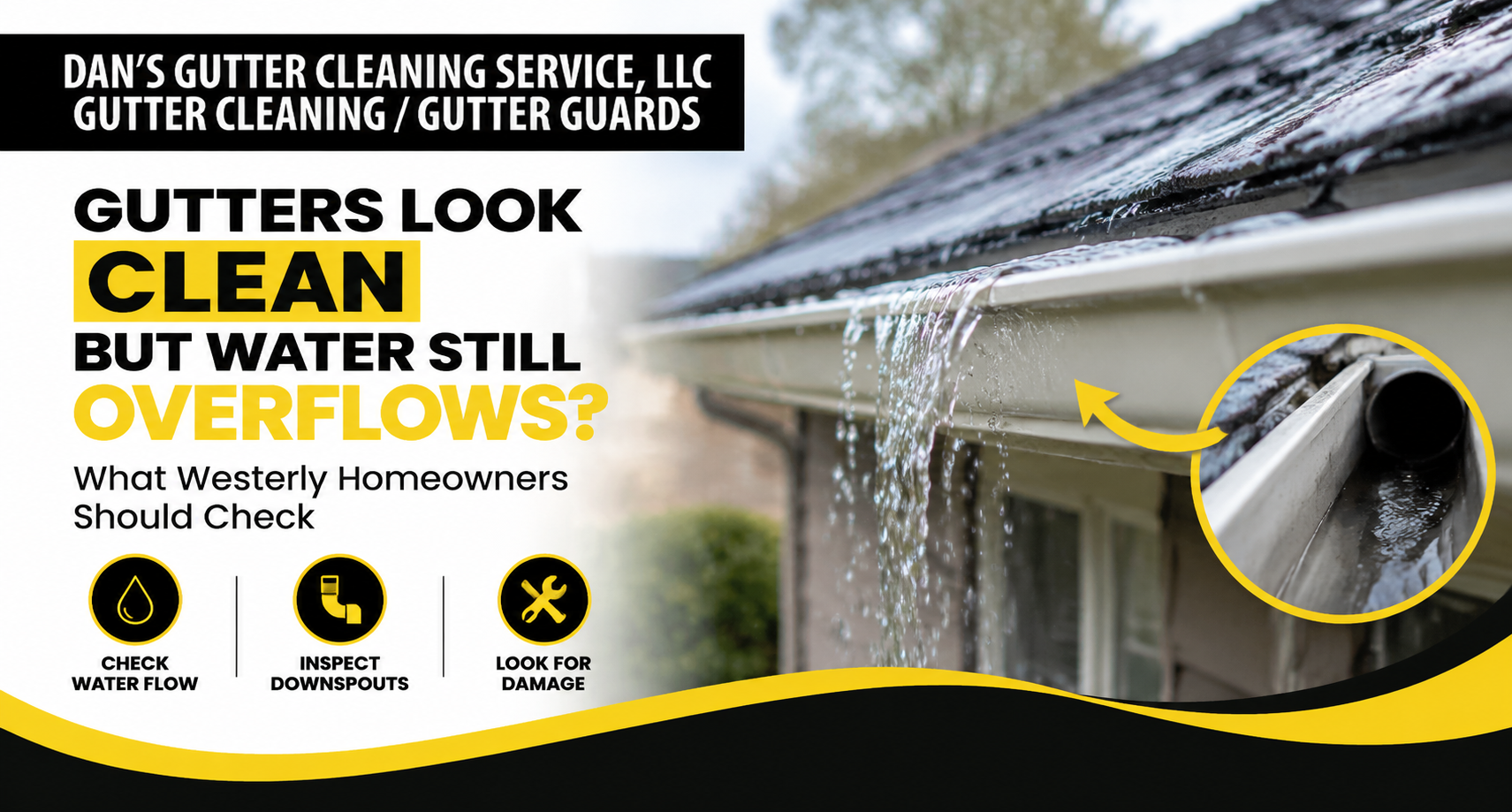
Cleaning your gutters regularly is one of the simplest ways to protect your home from water damage. Removing leaves, dirt, and debris helps keep rainwater moving through the system as intended. However, some homeowners discover that even after their gutters look clean, water still spills over the edges during rainfall.
If this happens at your Westerly home, the problem may not be visible from the ground. Clean gutters can still experience drainage issues caused by improper slope, hidden blockages, damaged sections, or problems with the overall gutter system. Understanding what to check can help you identify the real cause instead of repeatedly cleaning gutters that are not the source of the issue.
Clean Gutters Do Not Always Mean Proper Water Flow
Many homeowners assume that overflow only happens because gutters are full of leaves and debris. While clogged gutters are a common cause, they are not the only reason water may not drain correctly.
A gutter system has several parts that must work together, including the gutter channels, downspouts, connections, hangers, and drainage areas around the home. If one part is not working properly, water may back up or spill over even when the gutter itself appears clear.
This is why professional inspection and maintenance are sometimes necessary. Services like Dan Gutters help homeowners identify issues that may not be obvious during a quick visual check.
Check the Gutter Slope
One of the most common reasons clean gutters overflow is an incorrect slope.
Gutters need a slight angle so water can naturally move toward the downspouts. If a section becomes too flat or shifts over time, water may collect in certain areas instead of flowing away.
Standing water inside the gutter can lead to overflow during heavier rainfall. Homeowners may notice water spilling from one specific area rather than the entire gutter line.
Changes in gutter slope can happen because of aging hardware, heavy debris loads, weather exposure, or movement of the structure supporting the gutter.
Hidden Blockages May Still Exist
A gutter can look clean on top while still having a blockage deeper in the system.
Downspouts are especially important because they carry water away from the roofline. Leaves, dirt, small branches, or other debris can become trapped inside downspouts and restrict water movement.
When water cannot move through the downspout quickly enough, it may begin backing up into the gutter and overflow during rain.
If water is overflowing near a downspout area even after cleaning, the blockage may be located where it cannot be easily seen.
Inspect Gutter Seams and Connections
Modern gutter systems are designed with connected sections, and these connection points need to remain secure.
Over time, joints can loosen due to temperature changes, storms, and normal aging. Small gaps or cracks may allow water to escape before it reaches the downspout.
While this may not always create a dramatic leak, damaged connections can reduce the effectiveness of the entire system. Water escaping from seams can also affect siding, landscaping, and areas near the foundation.
Look at the Condition of the Gutters
Sometimes overflow happens because the gutters themselves are damaged.
Signs to look for include:
- Sagging sections
- Visible cracks
- Separation from the roofline
- Rust spots or corrosion
- Water collecting in certain areas
A gutter that is pulling away from the home may no longer maintain the correct slope. Even a small change in position can affect how efficiently water moves.
Homeowners searching for Gutter cleaning and repair near Westerly, RI should consider both cleaning and repair because removing debris alone may not correct structural problems.
Heavy Rain Can Reveal Hidden Problems
Sometimes a gutter system appears to work during light rain but struggles during stronger storms.
Heavy rainfall tests the entire system. If water suddenly overflows during intense weather, the problem may involve the gutter size, downspout capacity, drainage direction, or a hidden restriction.
Pay attention to where the overflow happens. Is it near one section of the roof? Does it occur only during heavy storms? Does water collect near the foundation afterward?
These details can help determine what part of the system needs attention.
Check Where Downspouts Release Water
A properly working gutter system does more than move water off the roof. It also needs to direct that water safely away from the home.
If downspouts release water too close to the foundation, the result can be pooling, soil erosion, or moisture problems around the property.
Make sure downspout extensions are positioned correctly and that water has a clear path away from the house.
Do Not Ignore Repeated Overflow
Occasional overflow during an unusually heavy storm may not always indicate a major issue. However, repeated overflow should not be ignored.
Water that consistently spills over gutters can affect landscaping, exterior walls, walkways, and foundation areas. Addressing the problem early may help prevent more expensive repairs later.
A proper inspection can determine whether the solution involves cleaning, adjusting the gutter slope, repairing damaged sections, clearing downspouts, or making changes to water drainage.
Final Thoughts
Gutters that look clean but still overflow are often experiencing a problem that goes beyond surface-level debris. Issues with slope, hidden blockages, damaged connections, gutter alignment, or drainage direction can all affect performance.
Westerly homeowners should look at the entire gutter system rather than assuming another cleaning will solve the problem. Understanding how each component works together can help protect the home from unnecessary water damage.
Regular maintenance combined with timely repairs can keep gutters functioning properly and help ensure rainwater moves safely away from your property.